
PORT HARCOURT: The realities of Idama begin with contradiction.
This small Kalabari island in Akuku-Toru LGA hosts oil-producing companies in OML 24 and OML 55 and contributes to Nigeria’s wealth. But for decades it has suffered prolonged neglect. Its only Community School and Health Centre are now dilapidated, and climate change is collapsing what is left of the community’s livelihoods. What should have been a place of pride has become a place for survival.
Ibiba Alaye Harry, 51, an indigene of Idama and graduate of Rivers State College of Health Science and Technology, was redeployed to the Rivers State Primary Health Centre, Idama. She came home to serve after working in Abonnema at the Akuku-Toru LGA Headquarters. As the years went by, she expected to stay in Idama, serving her people with normal work tools and at the minimum, a conducive environment. Instead, today, she works in a building that leaks, rots, and waits for rain. The building she serves in is gradually falling apart.
“Right now, there are no doctors. No nurses. No cleaners. Just one Community Health Officer and me, a lab technician,” she says.
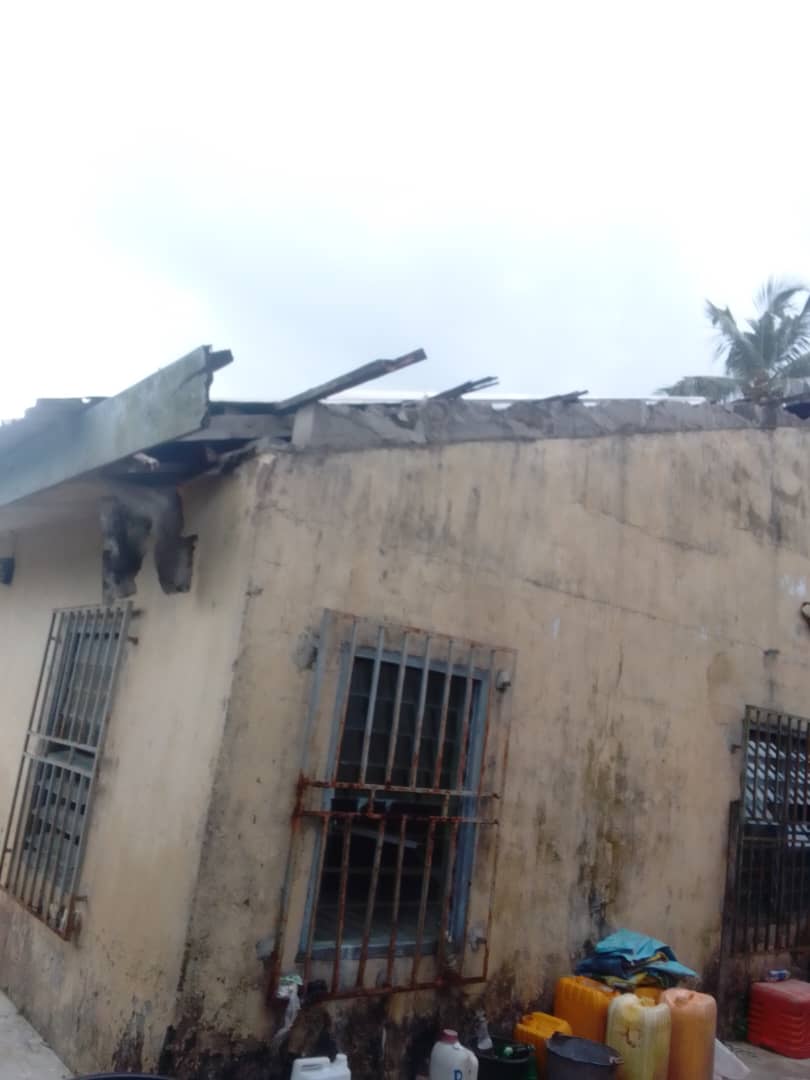
The rain comes down hard in Idama. It smells sharp. It eats metal. And for more than one year, it has been falling straight into one side of this Health Centre.
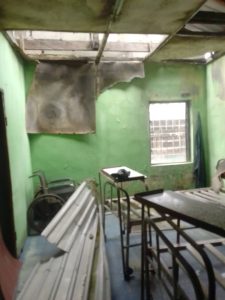
“One side of the Health Centre roof has been weakened by the acidic rain and blown off by the wind more than one year ago. It also damaged the walls. So critically ill patients cannot be admitted for proper treatment,” Ibiba says.
Climate change has made this worse. Over the years, rainfall patterns in the Niger Delta have become heavier and more erratic. According to the World Bank Group’s Climate Risk Country Profile: Nigeria, “An estimated 24% of Nigeria’s population (approximately 41 million people) are living in high climate exposure areas. Some of the highest overall exposure is concentrated in the coastal states, including Rivers State.” Dry seasons stretch. Then the rain comes hard. It hits the roof worse. And because it waits longer in the sky, it gathers more poison before falling on Idama. For a riverine island community built on wood and zinc, that is a death sentence for public buildings. Paints peel in no time. Nails rust in months.
When a Health Centre cannot admit patients, it is not a Health Centre anymore. Just four walls that put you more at risk than they help you. People come for treatment and are caught in between a flooded Health Centre and the choice to return home, sick. Or worse.
The Link Between Healthcare, Climate Change, Livelihoods and Survival in Idama:
For generations, women in Idama passed down Isam business: periwinkle harvesting. The creeks paid school fees, fed families, and seasoned Kalabari soup. Now the creeks are empty. The water is warm and salty in the wrong places, making major sources of livelihoods collapse. The Health Centre is falling with them because everything in Idama is connected. When the sea fails, livelihoods fail. When livelihoods fail, basic needs, including healthcare, fail along.
Madam Oluba, 72, an indigene of Idama, remembers when things were different. She now sells biscuits, sachet beverages, sachet water, detergents and soap from a small kiosk beside her family house to augment her declining periwinkle business.
“Life has changed a lot from the one we used to know during our days growing up. The sea is polluted. The air is too. As I speak, the acidic rain from gas flaring is destroying the roofs of homes, including mine.” Every rainfall leaves her in panic as new holes leave new footprints on her zinc.
She is not imagining it. In Ebocha, Rivers State, Amnesty International found residents making the same complaint. People described “black oil dust collecting in people’s homes and on clothes and food” from incomplete flaring, and “accelerated rusting” of roofs “because of acid rain associated with the flares.” Amnesty also noted that “some studies have found a link between gas flaring and acid rain and acid deposition” in the Niger Delta.
For over 20 years companies have flared here, making the rain more corrosive as the years went by. The flame is constant. The damage is cumulative.
Climate change is attacking the sea too. Rising sea levels and hotter water are pushing salt deeper into the creeks. A 2015 study from University of Uyo confirmed it: “coastal areas of Nigeria, particularly the Niger Delta, are experiencing salt water intrusion and erosion due to rising sea levels.” The World Bank Group adds that “An estimated 27 to 53 million people may need to be relocated due to a 0.5 meter increase in sea level, which is projected for Nigeria by end of the century.” That is not far away as it is within the lifetime of children born in Idama today.
The mangroves are gradually being destroyed: the natural shield that protects Idama from storm surges. With mangroves dying, floods reach homes faster, and the soil becomes too salty for food crops. Gardens that once grew plantain and vegetables now grow nothing. The same rain Ibiba is fighting in the clinic is the same rain school children and teachers in Idama are battling with at the community’s only school, while the rain eats Madam Oluba’s roof at home: representing the realities of majority homes in Idama.
Mr. Ipalibo Tom Princewill is 40. He grew up in Idama and went to Idama Community School as a teenager. Although his paternal roots is in Buguma, a neighbouring village, Idama is his maternal home and where he built his life.
He served as President of the Idama Ekulama Youth Organization in 2024 and he saw the collapse start with the school, while rapidly extending to the Health Centre.
“I wanted my son to grow up in Idama like I did. I studied in the Idama Community School. I taught in that school. I sent my son to that school. Then I pulled him out and had to relocate my family from Idama. The rain from gas flaring is eating the roofs of the lab and library. There are no textbooks. No equipment. The smoke and health hazards from the flares are too much. What future am I giving my child here?” He left because staying felt like failing his son.
He is right to be afraid. Amnesty International reported that in Ebocha, pregnant women “have reportedly had to leave the area because of exhaustion they relate to the gas flares.” Health experts warn that while direct studies are lacking in the Niger Delta, “combustion products of petroleum are known to have negative health effects, which include carcinogenesis,” and pregnant women are “more likely to be vulnerable to any airborne contaminants.” Despite years of complaints, Amnesty found that “neither the government nor the oil companies have carried out any specific study to look at health and flaring.” The air is monitored by no one. The health data is collected by no one.
If the school cannot stand, the Health Centre cannot stand either. The acid does not choose which public building to destroy. It falls on all of them equally.
WHAT’S NOT WORKING
1. Structural Integrity: A Building Eaten by Rain, Heat, and Time
Ibiba and one Community Health Officer are holding the Centre open with their bare hands.
“Right now, there are no doctors. No nurses. No cleaners. Just one Community Health Officer and me, a lab technician.” She repeats it because it is the truth that holds everything else.
Climate adds another layer. Higher temperatures and humidity in coastal Rivers State speed up corrosion: materials and buildings that should last 20 years now have a shortened lifespan.
According to the World Bank Group’s Climate Risk Country Profile: Nigeria, “Nigeria’s coastal states face extensive risks from storm surge along the entire coast, and inland flooding and wildfires in the Niger Delta region.” The report also notes that “ongoing coastal erosion, rising seas and oil pollution are destroying the Delta’s mangrove forest, a major buffer against storm surge from the sea.”
Without mangroves, storm water hits harder.
With hotter air, metal rusts faster. With more rain, wood rots faster. The PHC was not built to withstand 20 years of gas flaring plus hotter, wetter weather, simultaneously. It was built for a different climate.
The people who used to keep it clean and safe are gone.
“There were cleaners before and security. But some of them have retired, and some died. Right now, we don’t have anyone like a cleaner or security personnel.” So Ibiba locks th4 door herself. She also sweeps.
In addition, prior letters sent to the community king and oil company representatives: HRH KING KARIBOYE KARIBO OKIO III, TEINYA I: Amayanabo of Idama (Ekulama) Community, Chief Akobo Gogo-Abite Dateme, HCDT Chairman OML 24 and Ven Innocent Karibo, HCDT Chairman OML 55 the renovation of the Health Centre still await responses till date.
The silence is loud.
They asked for repairs to public infrastructure. To date, those letters still await responses. The silence is loud.
There is no steady power. Basic equipment is missing. The generator died years ago. The lab cannot run tests that require refrigeration. Vaccines cannot be stored. Night births happen in darkness with torchlights.
2. Staffing: Only Two Medical Professionals Serving a Full Community
This is the core crisis. Two staff for a whole community.
Ibiba puts it plainly:
“The number one priority now is to do a proper renovation work in this Health Centre and secondly, we need more medical personnel. They can bring at least one doctor for us. Even if he or she just comes weekly for proper consultations.” Weekly will be a start. Monthly will be better than nothing. Right now, there is zero.
3. Accessibility: Poor Options. Limited Choices
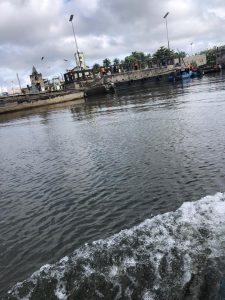
The only way in and out of the island is by boat. From time immemorial, there has been no bridge from Abonnema, the Local Government Headquarters, linking Idama to Port Harcourt. No bridge means no road and no ambulance during critical cases of emergency. Hence the 45-minute boat ride out of Idama. But getting a boat can take too long, from the ever-changing weather to the availability of the boats themselves. Boatmen charge more during rainy seasons. Sometimes they refuse to go at all as the stakes are high.
That is what turns a health emergency in Idama into a matter of life and death. A woman with labour complications, a child with convulsions, a man with a machete cut, all wait on the other side of the tide in Idama.
Precious Rhoda Obene, 34, an indigene of Idama, remembers when care was closer.
“The experience at the Health Centre wasn’t bad before because nurses used to be on-ground and available. So it was quite easy and accessible for villagers to get treated. The problem has always been that most emergencies can’t be met because there has been no equipment for a long time now. So if there’s any case of a critical emergency, there is no hope of treatment except the person is taken out of Idama.”
Families have lost people waiting.
That “taking out” means the 45-minute ride on a speed boat to the Abonnema Health Centre at the Local Government Headquarters. In daylight. In calm weather. At night, or during a storm, that ride may never happen.
Climate change is making it harder. The sea is rougher, the winds hit harder, and the tides are unpredictable. So boat travel gets dangerous more often.
According to NiMet’s Marine Meteorological Bulletin Q2 2024 “Strong winds and days of heavy rain made it dangerous for smaller vessels and disrupted… ferry services” in Nigeria’s coastal waters during late May and early June. The bulletin also notes that heavy rainfall “significantly reduced visibility, making navigation for small ships and fishing vessels more challenging” and led to “delays, rerouting, and cancellations of some maritime activities.”
During heavy rainfall, there is no way in or out. The island gets cut off.
“Most pregnant women leave Idama before delivery. But for those who cannot afford to, we try to help more in that area. There’s a local midwife who is an immunization official. She helps holistically with antenatal and postnatal. She attends specifically to pregnant women for check-ups and the delivery of their babies. Aside from this, almost nothing else is working here,” Ibiba says.
Source: Hello ICON Magazine
4. Affordability: Too Poor to Leave. Too Sick to Stay
“Right now, only HIV and malaria drugs are free,” Ibiba says. The supply comes in patches. The Health Centre lacks all other major drugs.
Everything else means paying for transport to Abonnema or Port Harcourt and buying drugs there. A trip there and back can cost more than the drugs needed.
“With the current declining money from fish and Isam (periwinkle) business, we cannot treat malaria in town,” Madam Oluba says.
This reflects a wider pattern across Nigeria’s coast. Dr. Oludele Solaja notes that in coastal communities, climate change and extractive industry have destroyed livelihoods, forcing residents to take on survival tasks abandoned by the state. He describes this as “climate security from below,” where communities organize drainage cleanups and mangrove planting to cope, even as governance gaps leave health and income unprotected. In Idama, the collapse of periwinkle harvesting means households no longer have cash for drugs and transport to town.
Warmer waters and pollution have collapsed fish and periwinkle stocks. The World Bank Group notes that “Increased food insecurity is also of specific concern following disasters which result in land and infrastructure degradation due to erosion, direct crop failure due to floods and heavy rains.” When Isam died, household income died. When income died, health became impossible. People now choose between food and treatment.
Behind this is a bigger system. Oil spills from illegal bunkering. Overharvesting. Waste choking mangroves. Companies operating through JVs with NNPCL in OML 24 and OML 55. And the Petroleum Industry Act 2021 that allocated “three per cent of oil companies’ annual operating expenses to local development” through Host Community Development Trusts.
More than three years later, the impact remains minimal. At a 2025 Town Hall Engagement with HCDTs and Settlors in Rivers State organised by the Nigerian Upstream Petroleum Regulatory Commission, the Host Communities of Nigeria Producing Oil and Gas (HOSTCOM) National President, Highness Dr. Benjamin Style Tamaranebi said: “Money has been paid to these trusts, and each of them holds billions. Yet, no trust in the Niger Delta can point to even a billion naira’s worth of visible projects, despite these funds being meant for development.”
In Idama, residents are asking: where is it?
They have asked loudly.
“We have been writing to the government. We have been writing to even the king. Last month, the local government chairman came to Idama for a thanksgiving, and he visited the Health Centre. I was the only one on duty when he came. That’s our chairman of Akuku-Toru LGA. He came, and he witnessed this himself.”
He witnessed it. The blown off roof. Everything.
WHAT’S WORKING
Very little. But three things have not completely collapsed.
1. Salaries are still coming
In a system where everything else fails, at least pay has not.
Ibiba says:
“We are paid by the Local Government and no, salaries are usually not delayed.”
It is one less barrier. Ibiba and the last Community Health Officer are still showing up, even without equipment, staff, or support. That consistency matters. It is why the clinic is not completely closed.
2. Community health workers are filling gaps
The government did not post a midwife. The community produced one.
Ibiba explains:
“Most pregnant women leave Idama before delivery. But for those who cannot afford to, we try to help more in that area. There’s a local midwife who is an immunization official. She helps holistically with antenatal and postnatal. She attends specifically to pregnant women for check-ups and the delivery of their babies. Aside from this, almost nothing else is working here.”
She does antenatal, delivery, postnatal, and immunization. One person carrying four jobs because the alternative is no healthcare at all.
3. Care still happens, sometimes
Even with no equipment, the PHC still treats what it can. For residents, that matters.
“In 2023, I had serious malaria when I was in the village, and they gave me drugs and injections, and it was good.”
– Precious Rhoda Obene
It is not a hospital. It is not equipped for emergencies. But for malaria, for basic care, two staff and a midwife are still showing up.
NEW POSSIBILITIES
Idama does not need pity. It needs solutions that already exist in Nigerian policy and are being piloted elsewhere. The money is not missing. The policies are already written. They just have not reached this island.
“Number one priority now is to do a proper renovation work in this Health Centre,” says Ibiba Alaye Harry, the lab technician holding the centre open with one Community Health Officer. “And secondly, we need more medical personnel. They can bring at least one doctor for us. Even if he or she just comes weekly for proper consultations.”
First, the roof and power. The Rural Electrification Agency has launched the e-H.E.A.R.T programme. It stands for “Energizing Healthcare and Educational Facilities for Resilience and Transformation.” The plan is to put solar power in 3,700 primary healthcare centres across Nigeria, according LEADERSHIP News. It targets facilities with no reliable power. The project is backed by $1.7 billion from the World Bank, African Development Bank and IFC. For Idama, solar means the lab fridge can run, lights can stay on during rain, and patients can be admitted again.
Second, the staff, drugs and renovation. The National Primary Health Care Development Agency leads PHC revitalization under the Basic Health Care Provision Fund. The gateway upgrades facilities with better infrastructure, electricity and water. It equips PHCs with essential medicines and diagnostics. It also supports recruitment and training of frontline health workers. The work includes stronger maternal and child health services and outreach to hard-to-reach areas. NPHCDA reports that over 7,000 PHCs have been revitalized across all 36 states and the FCT. Akuku-Toru LGA and Rivers State PHCDA only need to nominate Idama. The paperwork is not complicated.
Two people cannot run a health centre for an entire community. It is not safe and it is not sustainable.
Third, the money in the ground. Oil companies in OML 24 and OML 55 have paid 3% into Host Community Development Trusts since the Petroleum Industry Act 2021. HOSTCOM says the trusts hold billions, yet “no trust in the Niger Delta can point to even a billion naira’s worth of visible projects”.
Idama is a host community. Where is the borehole? Where is the renovation? Where is the doctor and nurses? Where is the power supply? The community is not asking for charity. They are asking for what the law already promised.
The cost of inaction is steep. The World Bank Group warns that “Given the dependency of Nigeria’s economy on climate-sensitive industries, climate change inaction could cost Nigeria between 6%–30% by 2050, equivalent to a loss of US$100–460 billion”. That loss will start in places like Idama.
Dr. Oludele Solaja calls what is happening in coastal Nigeria “climate security from below”. Communities clean drains. Plant mangroves. Deliver babies. Because the state is absent. But resilience is not a substitute for governance. It is evidence of its failure. People should not have to be heroes to get basic care.
The wards at Idama’s Health Centre have sat empty for years. The building remains without power, staff, or repairs despite repeated letters to authorities. Residents say the absence of basic services is driving more families to leave the community. Young people are leaving, tired of peaceful protests that lead nowhere. Elders are staying but getting sicker and suffering in silence. The Island of Idama is getting quieter.
Primary Sources /Community Voices (Field Interviews, Idama, 2026):
1. Ibiba Alaye Harry, Lab Technician, Rivers State Primary Health Centre, Idama – Field interview, 2026
2. Madam Oluba, 72, fish trader / periwinkle harvester, Idama – Field interview
3. Ipalibo Tom Princewill, 40, former President, Idama Ekulama Youth Organization – Field interview
4. Precious Rhoda Obene, 34, indigene of Idama – Field interview
Expert Sources and References
1. University of Uyo. (2015). Sea Level Rise and Coastal Erosion in Nigeria.
2. Nigerian Meteorological Agency. (2025, April 3). Marine Meteorological Bulletin Q2 2024.
3. World Bank Group. (2021). Climate Risk Country Profile: Nigeria.
4. Amnesty International. (2009, June). Petroleum, pollution and poverty in the Niger Delta. AFR 44/017/2009.
5. Nnaji, A. (2025, August 5). Forces against oil companies’ 3% fund allocation to host communities. The Nation.
6. Leadership News. (2024). REA’s e-HEART Project Targets Electrifying 3,700 Healthcare Centres With Renewables.
7. National Primary Health Care Development Agency. (2025). NPHCDA Gateway – Basic Health Care Provision Fund.
8. Solaja, O. (2026, March 2). Climate Security from Below: Community Environmental Action and Democratic Gaps in Coastal Nigeria. European Center for Populism Studies