
8:15 a.m. The weather and waters are fast becoming unfamiliar to the women who have known them all their lives.
Alapudokiari Benibo lives this change daily.
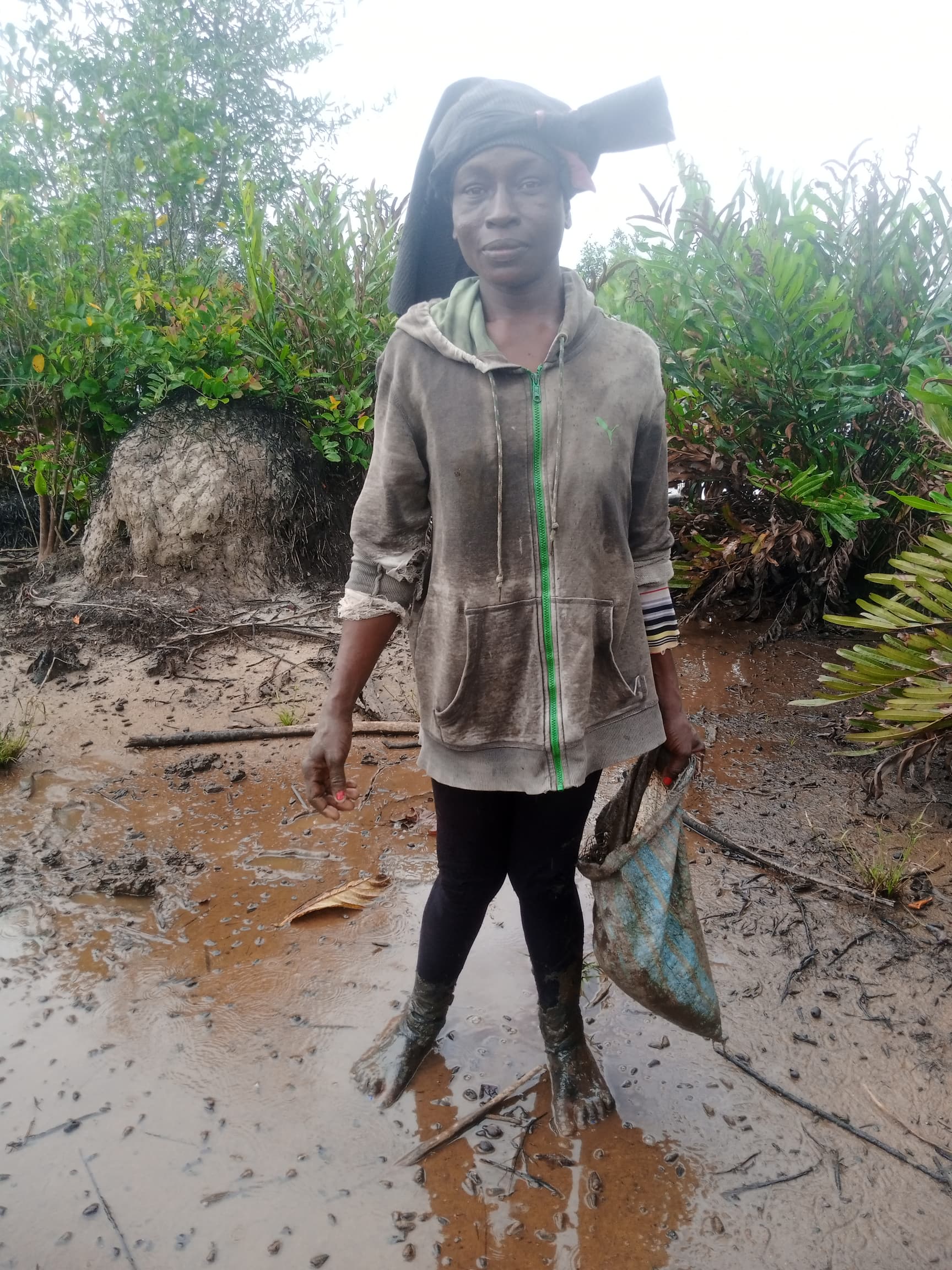
At this time, she is already inside Idama’s creek, wearing colours identical to the soil beneath her feet. She came prepared for what periwinkle picking has become: a struggle.
Grey cardigan. Black scarf tied tight over her hair. Black trousers covering every inch of skin against mosquitoes and sunflies. Each barefoot step draws her closer to her target and leaves a deep footprint in the swamp within the mangrove.
Periwinkle, popularly known as isam by the Idama Kalabari women, is vanishing from the creek she has harvested since her teenage days.
Benibo paddled her canoe 30 minutes from the main Idama island to get here, in search of periwinkles. On some days, it takes longer. Things were not this unpredictable in the last decade, but with every sea rise and nonstop rainfall lately in Rivers State, the struggle increases.
She came with a sack held tight in her grip, putting each periwinkle she finds into it. If what she gathers can fill ten custard buckets at four litres each, it will be a successful day. That is her target before the tide turns.
The world has a target too: to protect 30 percent of oceans by 2030 under the 30×30 pledge. In Idama, that protection is nowhere close to reality. Not for the fisheries. Not for the mangroves they call home. Not for the people who steward them.
“Na suffer we dey. Everything about this periwinkle business, na suffer. Na him make we dey grow old,” she told Hello ICON Magazine in Nigerian Pidgin English.
“To pick am, you go suffer. To carry am, you go suffer. To gather am, to say make you carry go market, another suffer,” she continued, walking further into the swamp with unflinching focus.
She believes a lot has changed from the days when weather and waters were predictable. Access to viable periwinkle for food and profit is harder to reach, unlike when this trade was passed down to her from her mother in her teenage years. Today, periwinkle harvesting comes with a silent prayer and a heart determined not to go home empty-handed.
This has become the cycle of survival for Benibo and her children, whose basic needs depend on their mother’s struggle.
IDAMA’S Era of Silence
This story centres on the women who power Idama’s periwinkle economy. It is Part 2 of a 3-part, 30-month investigation.
Part 1 uncovered how Idama hosts two oil companies yet its people live in extreme poverty and biodiversity loss, a direct contrast to the world’s 30×30 marine target. It documented dying mangroves from oil spills and bunkering, the local term for illegal artisanal refining, and acid rain from gas flaring eating through the roofs of homes, the only community school and the only health centre.
Part 1 broke more than a decade of media silence. Idama was last covered by mainstream media 12 years ago by Vanguard.
IDAMA After Part 1
After Part 1 was published, ten fishing boats were provided for fishers in Idama under the OML 55 Host Community Development Trust led by Chairman Ven. Innocent Karibo. OML 55 is operated by Belemaoil Producing Limited.
Weeks later, the OML 24 Host Community Development Trust led by Chairman Chief Akobo Gogo-Abite Dateme conducted a two-day needs assessment of dilapidated infrastructure. OML 24 is operated by Newcross Exploration and Production Limited.
HRH Kariboye Karibo Okio III, King of Idama, said efforts were ongoing to fix the school and health centre, noting that primary responsibility lies with government. “Any moment from now we are going to work on the health centre and the school,” he told Hello ICON Magazine.
Under Sections 235, 239(3) and 240(2) of the Petroleum Industry Act 2021, oil companies must contribute 3 percent of actual annual operating expenditure from the preceding financial year to the Host Community Development Trust. The fund is meant to finance infrastructure and economic empowerment for host communities, including women-led livelihoods like periwinkle harvesting.
IDAMA’s Realities: Where Climate Science Meets Local Knowledge
“When the water rise too much, we say, water don spoil because we no go fit pick periwinkle when water full everywhere. When we start to pick periwinkle inside the angala from morning around 7 a.m. or 8 a.m., before, we fit dey there till evening, but now, we fit leave before even 11 a.m. or 12 p.m. because if water start to enter and return, na signal to dey go house. If we leave, we come back again around 2 p.m., stay till 4 p.m. or 5 p.m. Nowadays, when water enter, e dey float for longer days before e dry. When the water dry, we go back again with our canoe.”
Opiriboyanam Palibo Obene, 55, shared this with Hello ICON Magazine, reflecting the lived realities of Idama women whose major source of livelihood is periwinkle harvesting. Before she lost her husband in 2022, Obene had been an economic anchor for her family through the periwinkle trade, which for many households in Idama pays for feeding, clothing, healthcare and school fees.
This is how the women read the tide from the mangrove they call angala. What climate science calls sea level rise and increased precipitation, they call water don spoil. In Idama, sea level rise is not an abstract projection, it is a daily calendar that decides if they eat.
That gap between language and lived experience is where experts start.
“Climate change is a buzzword. It doesn’t always have meaning for people trying to live day to day,” said Ilan Kelman, Professor of Disasters and Health at University College London, in an interview with Hello ICON Magazine.
For scientists working on the coast, the women’s reading of the tide counts as data.
Ojo Akinrotimi, Director and Head of the Mariculture Department at the Nigerian Institute for Oceanography and Marine Research, told Hello ICON Magazine that periwinkle is “not simply another aquatic organism, but food, income and part of the traditional economy for women in coastal households.” The women’s experience, he said, should be taken seriously as local ecological knowledge.
Economists frame the same reality as a justice failure.
Ikenna Donald Ofoegbu, economist and Manager of the Sustainable Nigeria Programme at the Heinrich Böll Foundation, described it as a failure of ecological justice. For Ofoegbu, ecological justice means communities that bear the environmental cost of oil and gas production should not be left to bear that cost alone. For Idama, he said, it must mean more than compensation for spills. It must mean prevention, restoration, protection of livelihoods, and a meaningful voice in decisions about their environment.
Back in the angala, that failure is felt in the body.
“I’m doing it before I born all my children, but now, periwinkle is very hard to see, we have to go inside inside before we get. E no easy. Sometimes you fall inside the angala mud. Sometimes your leg go hang inside. Stick go chok you,” Obene recounted.
Benibo, whose feet were already caked in creek mud at dawn when this story opened, added: “Mostly, we the women, na our work be this. If you no pick periwinkle how you wan take chop. Na wetin we dey take survive o. The oil bunkering wey dem dey do before no come make the periwinkle plenty again. No be only periwinkle o, even fish for water. Plus strangers sef dey come dey collect the periwinkle dey carry go.”
The extra hours in the mud are already a measurable indicator of decline.
Akinrotimi said, “If the same amount of effort is producing substantially less periwinkle than it did previously, then the population density or accessibility of the resource is likely declining,” noting that for periwinkle, the quality of intertidal sediment and mangrove habitat determines abundance and distribution.
What looks like hard work is, in economic terms, rising vulnerability.
Popularly known as Mr Climate, Olumide Idowu, Founder and Executive Director of the International Climate Change Development Initiative, ICCDI Africa, told Hello ICON Magazine that if women have to spend several additional hours travelling to harvest the same quantity of periwinkles, their effective cost of production has increased and it is a form of livelihood vulnerability. He said resilience should not mean asking women to simply work harder to survive environmental decline.
Reading The Weather and Water
Like Benibo and many other periwinkle women in Idama, Obene learnt the trade from her mother as a teenager. In 2014, her daughter, Precious Rhoda Obene, now 34, joined her shortly after her West African Senior School Certificate Examination (WASSCE) at Idama Community Secondary School. She was 22 at the time.
For Precious, the business was fun at first. She used to sneak out of their home to join her mother against her father’s will. But with each year, under the long-term impact of oil spills, oil bunkering, periwinkle overharvesting and unpredictable weather, the business became harder.
For her, the clearest sign of that change is not in the catch, but in the sky and water.
“Older Idama women and people like my father could accurately tell you the time by simply observing the weather and water. For instance, they can simply look at the weather and water and tell you it’s 4 p.m., if you check the clock, it will be either exactly 4 p.m. or very close to. But today those two elements are no longer so predictable. We hear it’s climate change,” she said. Idama periwinkle harvesters also use this knowledge to know when to leave the angala, even without wristwatches.
That loss of predictability is what makes climate change so disruptive for work that depends on reading nature.
“Climate change has two main overlapping impacts. First, it amplifies whatever existing weather-related problems you have. Second, it creates a new unpredictability. Seasons get mixed up, rain falls when it previously didn’t. For people whose livelihoods depend on the land, you need predictability. Without it, it becomes extra hard to do the basics of your profession,” Peter Schwartzstein, environmental journalist and expert on climate and conflict, told Hello ICON Magazine.
Precious traces much of that reading of the water to her father.
“My father would have told you a lot about the water, periwinkle and fishes if he was alive. He lived in Idama all his life, 1949 to 2022. He knew so much about Idama’s marine ecosystem that he was nicknamed after the mangrove. People called him Angala,” she said. She described her father, Palibo Oruinye Obene, as a custodian of Idama’s history. Idama community lost a wisdom bank when he died at 73.
Science complicates the story. Climate is a pressure, not the only culprit.
Akinrotimi noted climate change as an additional pressure on Niger Delta coastal ecosystems, but cautioned against using it as a convenient explanation for every decline. “Climate change should not become a convenient explanation for every decline in periwinkle abundance,” he said. He explained that periwinkles are adapted to particular ranges of salinity, temperature and oxygen. When rainfall patterns, freshwater discharge or sea level change, the salinity regime of creeks can also change, altering where they can survive and reproduce.
For island communities like Idama, that shift hits harder because support is thin.
IDAMA’s Interconnected Challenges: Rooted in Community Voices and Expert Knowledge
Loss of Livelihoods:
Bearing the Brunt of Climate and Ecological Injustice
“Even the weather sef no be am. Sometimes we dey carry empty hand dey go home. Sometimes, God dey help us, we dey see like five kon kon. Four kon kon, carry come house come manage,” Roselyn Iyalla told Hello ICON Magazine while counting the morning’s meagre pile. Unlike many other Idama women who learned the periwinkle trade from their mothers, she learned it from her grandmother.
Her account points to a deeper pattern of neglect for frontier communities.
“For small islands like Idama, they often lack resources. They are not paid attention to. Then the weather changes a bit and they are in trouble,” Kelman said. “It is not about explaining climate change to them. It is a dialogue about what they know, what they need, and what their knowledge and wisdom can offer.”
That trouble is now measured in distance and exhaustion.
“Some days when you go, you go waka bush finish, two, three bush you never fit get one kon kon. Before e no be like this. Before e no even far, small place you don pick more than one bag of rice. Now we dey paddle far,” Iyalla added.
For Idama women, paddling and trekking for hours has become the only way to find a catch. What they feel on the water, science confirms in the lab.
Akinrotimi described it as an increase in harvesting effort per unit of catch and linked it directly to a regeneration crisis.
“If harvesting is intensive and people continually remove the larger reproductive individuals without allowing sufficient time for recruitment and growth, the population can become dominated by fewer and smaller individuals. Eventually, harvesters have to move farther away to obtain commercially useful quantities,” he said.
Beyond overharvesting, the water itself is changing.
“Studies from Rivers State and other Niger Delta locations have documented petroleum-hydrocarbon contamination and heavy-metal accumulation in Tympanotonus fuscatus,” he said, referencing experimental work in the Bonny estuary that found drastic changes in periwinkle density following crude-oil exposure.
Food Insecurity:
The Cost of Environmental Degradation
“Periwinkle na our way, our survival. For pikin when don grow, as your mother dey do am, you too you go follow do. 10 years ago, the periwinkle plenty and people wey dey pick am dey very few. But this time now, people wey dey pick periwinkle don too much oh. Because the kpofire wey boys dey do to take help themselves, e no dey again. So everybody now na periwinkle,” Benibo said.
Back in the creek, she links the surge to extreme poverty and overreliance on a single livelihood, after government ended artisanal refining. What remains is the long-term effect of oil activities on water, weather and mangrove.
In Idama, periwinkle is gold.
“What policymakers miss is that periwinkle is not just a commodity on its own. It is part of household food, it is part of household income, it is part of the informal financial system that allows rural women to have some kind of access to small credits, it is also part of women and gender empowerment,” Ofoegbu said.
When periwinkle disappears, it pulls everything with it.
“Since the periwinkle beds are disappearing, we are not just witnessing loss of shellfish alone, we are also witnessing erosion of the food system, erosion of women’s voice, erosion of income and financial inclusion and erosion of communal and local institutions that depend on periwinkle income,” he said.
The loss is counted in kon kon at the market.
“We dey measure five kon kon. If na big seed of periwinkle we sell 8,000 naira. If market bad, we sell am 5000 naira. But if you see 10 kon kon when the market favour you, you go sell 22,000 naira. If market no good, 18,000 naira for the 10 kon kon,” Iyalla said.
For women like her, no periwinkle means no food money.
That failure connects directly to wider instability.
Speaking on the interaction between climate change, peace and security, Gabriel Lagrange, Climate Security Expert, Research, Policy and Advocacy, West Africa and Geneva, said, “There are four ways climate change interacts with peace and security. The first is food and water security. What matters is you can eat and you can feed your family. Without eating or without drinking you will die. That is the basic need. When people do not have the resources to eat, one possibility is to move to search for food in other settings. In fragile areas where there are already tensions and not enough resources for all people, you have more and more people for less and less resources. That creates tensions between displaced communities and host communities.”
Health Hazards:
The Body Burden of the Isam Woman
“We no dey fit meet up with beta money to buy medicine for body pain. This business go disfigure you. You go suffer for angala. Even when you succeed to carry come reach house, if you no fall, snake go pursue you. When you don reach house, sometimes you no fit waka straight again,” Iyalla said.
That pain has a clinical name, and a larger ecological context. The Niger Delta mangrove forest is the fourth largest mangrove forest in the world and the largest in Africa. Per unit area, mangroves can store up to four times as much carbon as terrestrial forests, making them critical blue carbon ecosystems. When they are cut and polluted, the coast loses both a climate shield and a health shield.
The link between forest loss and human health is direct.
“It plays a very major and critical role in the fight against climate stress and greenhouse pollution,” said Dr Bieye Renner Briggs, a public health physician and occupational safety expert who leads the Community Environmental Protection and Health Foundation (CEPHF) and is known in Port Harcourt as Dr Soot for his StopTheSoot advocacy.
“Without the mangrove forest in the Delta, the manifestations of climate change would have been worse on human health, biodiversity and livelihood,” he continued. “This is why the government needs to protect the mangrove for the critical role it plays in the fight against climate stress.”
Speaking with Hello ICON Magazine, Briggs breaks the exposure of isam women into three routes.
Inhalation. Soot from gas flaring and from artisanal crude oil refining, locally called Kpofire, hangs in the air. It grows so thick it settled on floors, cars and door handles, and could travel kilometres. The women breathe it while they pick.
Ingestion. Isam concentrates oil. “These aquatic animals have a way of concentrating hydrocarbon. So when you consume them, you are consuming hydrocarbon,” Briggs says.
Dermal contact. Picking means wading through polluted water. “Water contaminated with hydrocarbon through your skin, we call it dermal contact, it can also gain access to your bloodstream.”
Once inside, he explains, “Red blood cells have a higher affinity for carbon than they do for oxygen.” Instead of oxygen, they pick carbon and carry it to “the nucleus, the engine room of every cell, where the DNA is produced,” where it can “produce abnormal chains that can cause diverse illnesses.”
Hence his warning: “There is no system of the human biology that is spared from the manifestations of hydrocarbon exposure.”
Short term, the symptoms are visible.
Itchy skin, rashes, eye irritation, asthma, bronchitis, vomiting, diarrhoea, abdominal pain, acute kidney injury.
Long term, the damage deepens.
Chronic bronchitis, lung cancer, respiratory failure, cardiomyopathy, ischemic heart disease, heart attack, cardiac arrest, chronic kidney disease, kidney cancer.
For isam women, the sharpest cost is reproductive. Briggs cites a 2018 Rivers State study that found structural abnormalities in the sperm cells of most male residents of Port Harcourt. In women: infertility and premature ovarian failure. In pregnancy: “risk of miscarriage, congenital abnormalities, intra-uterine foetal death, intra-uterine growth restriction,” and after birth, “risk of sudden infant death, low birth weight, prematurity.”
Briggs points to Ogale in Eleme as scale. In 2011, UNEP found benzene at “nine hundred times beyond the allowable limit” in a community drinking well there.
Eco-Grief and Eco-anxiety:
Life in a Climate-Altered World
“It’s a very difficult business, and Idama women are suffering. Yet the business is what they use to train their children. Look at me, my son, Alalibo, it’s isam that I picked to train him to become a lawyer,” Madam Oluba, 72, was one of the oldest periwinkle harvesters in Idama. She began during the good old days before she stopped due to age and because the work became too hard for too little return. She now runs a small provision shop beside her house.
“The weather my God! Even since how many weeks now, bad weather. Yet Idama’s strong periwinkle women still go. But people like me because of age can’t go again. Even other villages come to Idama creeks to pick periwinkle whether rain or sunshine,” she said.
In Idama today, grief is wrapped as strength and quiet resilience.
A typical harvester now paddles between 30 minutes and two hours in search of periwinkles. When she finds a spot, she gets off her boat and walks barefoot into the mangrove swamp to meet her target: the number of kon kon she is determined to find for the day.
Beyond the creeks, grief sits inside homes.
Oluba’s own house, like many others in Idama, is riddled with holes in the roof from years of acid rain. That grief is preceded by eco-anxiety, the dread that comes with every sign of rainfall. The mental and physical stress of gathering buckets and basins under your own roof to catch rain on the days and nights when the floods come.
“Before we dey make am, as the isam dey inside the bush, but now isam no dey. We no dey fit meet target. Before, the price no too dey high, but we dey see enough dey pick and e dey sustain us, but now, as e no dey, the small one wey we dey pick, e dey cost,” Iyalla said.
Grief escorts women who return empty-handed with children to feed, body pains to treat and debts to pay. It moves from parents to children who can no longer continue school because the ecosystem that funded it is collapsing.
When the mangrove no longer holds periwinkle, it takes more than income. It takes a heritage handed down from mothers, the knowledge of which bend in the creek holds periwinkle when the tide is low, which root to grip so you don’t slip, which song to sing to keep rhythm while you pick. When that mangrove dies, that heritage has nowhere to live. They don’t just lose what they sell. They lose who they are.
For the women of Idama, the loss is not only economic. It is identity.
“We dey give time to pick. Like this water when you pick, the next water you no go enter that same water. But people wey dey come from outside to pick for our side no dey obey our law,” Iyalla said.
That breakdown of communal law brings a different weight.
Grief also sits with Ibiba Alaye Harry, 51, health technician at Idama’s Primary Health Centre, the same clinic that should treat periwinkle women when they fall sick from the hardship of the mangrove, but it currently lacks basic tools and medical personnel, not even a doctor or a nurse. Parts of its roof have been blown off without repair for over a year, Ibiba told Hello ICON Magazine.
For Precious, who lost her father while she was away from home trying to give him and her family a better life, that grief is daily.
“Omo, I miss that man a lot, I’m still pained,” she said.
Climate Conflict:
When Scarcity Turns Neighbours Into Rivals
Scarcity is changing how Idama relates to its neighbours.
Precious recalled an informal code: harvest only mature periwinkles, leave certain creeks to replenish.
“There is no governmental law to this effect. This was just our own way of protecting what we have to survive,” she said.
That system has collapsed. Now neighbours from Andoni and Idama’s own people harvest everything.
Ofoegbu calls it institutional invisibility. The state responds to incidents, not the system.
“The strangers with us dey quarrel. Some no be even Kalabari people sef. As other people dey follow us dey pick wey no be from this area, we no dey succeed. We dey even pursue dem for bush make dem commot make we see something pick.” Iyalla said.
Dr Chukwudi Njoku, geographer, lecturer and founder of Pan-Adrian Initiative for Development, spoke on how livelihood collapse becomes a peace risk.
“Environmental degradation and livelihood insecurity have become a significant peace and stability risk,” he told Hello ICON Magazine. “In communities like Idama, oil spillage and pollution compound pressures on fisheries, creating grievances and competition over resources. Without credible responses, they erode trust and create conditions for conflict.”
That slow erosion is not just about empty nets. When survival gets harder, the pressure first lands at home.
“Violence often builds extremely slowly, almost imperceptibly. It’s like a frog in a cauldron of boiling water. And it often begins at home. Violence against women or kids can be a warning sign of intensifying unhappiness and misery, because that violence at home often has similar roots to violence in the public sphere. And when you are a community in the geographic periphery of a country, it becomes easier for authorities to ignore the problems,” Schwartzstein said.
He added: “Scholars in the climate security field have found three factors that make communities extra susceptible to climate-related violence. One is having a large percentage of your population engaged in agriculture, which is true in Idama. Two is having a history of recent or ongoing conflict. And three is having exclusive political systems that respond to public unhappiness with force rather than with more considerate tactics.”
Forced Migration and Talent Exits:
From Idama’s Struggles to Untold Hardships
“Everything I have in life has been drowned in water. Due to heavy rainfall in Port Harcourt, flood entered the compound where I live. All my properties. My electronics. My foam. My seats. All gone,” Ipalibo Tom Princewill, 40, former Idama Youth President, told Hello ICON Magazine.
This happened barely a year after he left Idama with his wife and two sons to give them a better life, including access to better education and healthcare. In September 2026, he met a different catastrophe: flooding in Port Harcourt, the Rivers State capital.
As a former teacher at Idama Community School, his relocation was not only a cost to his young family but a loss to Idama’s education system, already suffering from buildings destroyed by acid rain and a lack of teachers.
Each youth who leaves Idama carries the same goal: to find a better life.
“My mother’s generation knows how to endure a lot. But my generation, we have our limits,” Precious said. That line marks the difference between two eras of Idama women. Her mother could stay in the mangrove from morning till evening. She cannot.
To support her family, Precious left the periwinkle trade and moved to Port Harcourt after it became “too stressful.” Pollution, she said, had killed periwinkles to their roots. “Nowadays, one has to paddle very far to find any periwinkle.”
“The periwinkle, youth sef dey pick, mothers dey pick. But mothers dey pick more. Because the mothers dem sabi pass the children. Some of the youth never even know how to pick am, na learn wey dem dey learn,” Iyalla said.
Precious is one of the Idama youths whose childhood was sustained by her mother’s periwinkle trade and her father’s fishing. Before the collapse, parents could use profit from the creeks to train children to university. By the time she had to go, the fisheries could barely sustain feeding. She saw herself through university, selling food items to survive.
Precious’s dream was to leave home, find a better life, and return to lift her family from poverty. But she faced more hardship in the city than she envisioned. She lost her father, the Angala himself, in the same year she graduated from university, 2022. Today, Precious is a graduate of English and Communication Arts from Ignatius Ajuru University of Education, Rumuolumeni, Port Harcourt. Four years after graduation, she is still searching for stable work. She survives on a petty perfume trade and occasional contract work as a chef.
The lived experiences of Ipalibo and Precious represent the shared reality of Idama youths who leave the community in search of greener pastures, only to meet a different level of hardship.
IDAMA’S Future: Human-centred Co-design by Community Voices and Expert Knowledge
From Idama to 30×30: Community-led Mapping and Protection
The first step is to map where periwinkles used to be plenty and where they are now, combining what the women know with scientific surveys of water, mud and periwinkle size.
“Let the knowledge of the women and fishers guide scientists to the traditional beds, let scientists measure what is happening to the population and habitat, and let them jointly develop rules for recovery,” Akinrotimi said.
He proposes a committee of women harvesters, traditional rulers, fishers, youth, neighbouring communities, NIOMR scientists and Rivers State officials.
“Those who depend most directly on the resource should have a meaningful role in making and enforcing the rules, while government provides legal backing,” Akinrotimi said.
He points to Niger Delta examples where this worked. In Nembe, Bayelsa, research documented the use of communal taboo to develop fisheries rules, including restrictions on destructive fishing methods, with improved conservation outcomes after enforcement. In Rivers State, research documented community-established conservation areas, while restoration initiatives in places such as Kono involved local monitoring and protection of mangrove resources.
Fortune Onyekwere, agro-environmentalist, told Hello ICON Magazine that she proposes a low-cost reservoir system for Idama, like crop rotation at sea. Harvest one bed, leave it fallow to rebuild from juvenile to maturity, move to the next. She points to Abia, where a community declared its forest sacred and taboo to cut or hunt. The ban was time-bound, allowing the forest to recover before it was reopened. For Idama, that means harvesting zones, temporary closed areas, minimum size limits, banning destructive methods, controlling outside access, joint monitoring and transparent conflict resolution.
The gap is enforcement. Idama has no legal backing for its waters and no support for women during closed seasons. Without a formal agreement with Rivers State and alternative income while periwinkles recover, community rules will be hard to enforce.
Akinrotimi says Nigeria’s 30×30 commitment under the Kunming-Montreal Framework must be more than boundaries on a map. For Idama and the Niger Delta, he lists: identify and map biodiversity hotspots and traditional fishing grounds, recognize community-managed areas as official conservation, restore degraded mangrove and intertidal habitats considering tidal flows and livelihoods, establish scientifically monitored shellfish refuges as temporary or permanent no-take areas, strengthen pollution monitoring and enforcement because a protected area cannot stay healthy if oil and waste keep entering, put coastal women at the centre because they hold detailed knowledge of seasonal distribution, and link conservation with alternative livelihoods so women are not told to stop harvesting with nothing to feed their families.
Livelihood Diversification and Early Warning
“If they can help the periwinkle women to start another business because the struggling is too much inside bush. Walking in the thick swamp and mud. Everything. Some of the women are sick now. Mosquitoes are a lot at the mangrove. You know mosquitoes causes sickness? Periwinkle harvesting is a very tough business. Idama women are strong women. Very strong,” Oluba said, from her experience having lived for over seven decades and spent more than half of her life in the periwinkle business in Idama.
This is the diversification of livelihoods goal Abigail-Tyedale Bassey supports and has seen work in other Niger Delta communities. Bassey, a policy researcher who works at the intersection of climate displacement and migration, told Hello ICON Magazine, pointing to Cross River, also in the Niger Delta, where a project restored 15 hectares of mangroves while training over 4,800 people, mostly women, in climate-smart agriculture.
“Diversification is key. When we look at coastal communities, they just rely on water. We are taught this is a farming community, this is a fishing community. There is no thinking outside the box,” she said.
“It is not necessarily Dangote diversifying from cement to salt; it could just be around the same thing but a different method, so that everything does not hit you at once.”
For Idama, that could mean mangrove restoration paired with women-led fish processing and youth skills training.
She recalls a young man on a field trip: “Education is not just formal, skills acquisition is also a form of education. Government has forgotten about people like them.”
“I believe there are people in Idama like him, willing and ready to take up new ventures to survive.”
On early warning, Bassey said: “We are not doing enough.”
In Bangladesh, the Cyclone Preparedness Programme uses over 70,000 volunteers, half women, using local language to warn and lead people to shelter. A World Bank program combined embankments, drainage and reforestation to protect over 400,000 people, half women. It worked because warning was linked to action.
For Idama, women and youth as local monitors could give flood warnings by radio and market announcements, linked to evacuation and cash assistance.
The risk is that skills and warnings fail without funding and trust.
“It should connect to what is the way out,” Bassey said.
“Women are almost the worst hit. Like periwinkle harvesting, it is women’s work,” she added.
Building Idama’s Resilience Hub
For widows and single mothers who return empty, recovery must go beyond harvesting.
A resilience hub, co-designed with Idama women, for Idama women, would not replace the angala, but hold the women when the angala cannot.
Having led and facilitated successful programs at the intersection of climate change, monitoring and evaluation, communication and sustainable development, Idowu shared what a proven solution looks like: “If we want to reduce talent exit in Idama, we have to make the community a place where young people can see a future. A talented young person should not have to leave Idama simply because there is no opportunity to apply their skills locally,” he said.
The hub, he added, could create internships, apprenticeships, community research fellowships, and digital storytelling to help women market their periwinkles, plus partnerships with nearby universities.
Inside the hub: native fish farming in pens away from polluted creeks, better processing and storage to add value, paid roles for women as creek monitors and mangrove restorers, and waste recovery hubs.
For Idama’s hub, Onyekwere’s model is segregation at source, weighing recyclables for cash, linking to firms that convert plastic to pellets for export. She calls it a win-win because good environmental health equals good human health.
She insists on Learn-Do-Earn-Lead: youth and women lead the hub, not one-day clean-ups for pictures. Women-led resource groups headed by youth and environmental clubs in schools to sustain practical action after cameras and NGOs leave.
For Njoku, Idama’s hub must be more than a building. “It should become a trusted platform where environmental risks are identified, evidence is shared, responsibilities are clarified and commitments are tracked,” he said.
If this works, Idama becomes not just a case study of a disappearing resource, but a demonstration of how a Niger Delta community can restore and sustainably manage its own shellfish. A community that produces knowledge, develops young environmental leaders, restores its ecosystem, and creates economic opportunity from sustainability itself.
Walking toward solutions for real-time and sustainable impact, Idama’s youth and periwinkle women must be at the centre of co-designing the Resilience Hub prototype, where women hold ecological knowledge and young people lead oil pollution monitoring, storytelling, and green enterprise in the form of waste-to-wealth. A hub that will host the first women and youth-inclusive accountability dialogue with multi-stakeholders, where citizen journalism meets citizen science to bridge the longstanding accountability, over-dependency and knowledge gaps in Idama.
“You can’t know Idama more than Idama people,” Briggs said.
Under the United Nations framework, 188 governments made the 30×30 pledge, including Nigeria. But in Idama, the women who are the real stewards of the marine ecosystem are oblivious to this target. The only target they fight for is how to fill at least 10 kon kon of periwinkle and survive under leaking roofs, dilapidated infrastructure and a degrading environment.
Akinrotimi says Idama’s story is an early warning from the ecosystem. Periwinkle beds can recover if water and mangrove conditions remain suitable and harvesting pressure is reduced. “But recovery will require more than asking women to harvest less,” he said.
“Every solution should be based on real-life realities and the experiences of the people it will be built for,” Kelman said.
Till then, Benibo will keep returning to the creek on days when “water no spoil,” battling to fill each kon kon.
“When the water don spoil, we fit dey house sometimes till 12 p.m. before we go commot and if we commot like that, we go still pick o reach evening 5 p.m. The day wey I pick plenty periwinkle, I dey very happy oh, because I know say if I sell am, I no go only buy garri, I go buy other things to cook too, me and my children go eat,” Benibo said.
In Idama, the sea cannot be saved until the people who guard it are seen.
Editor’s Note: This story was produced with funding from The Colonist Report Africa as part of the 2030 Marine Conservation Target reporting initiative, supported by the Earth Journalism Network.
Disclosure: The reporter bears the same surname as interviewee Alapudokiari Benibo, but they are not related.