
Editor’s Note: Nigeria has the technicians. What it lacks is the system to make them productive. In Part 1 of this 8-part series, Johnable Chima Amagwula outlines why Eco-Industrial Parks may be the framework to fix that.
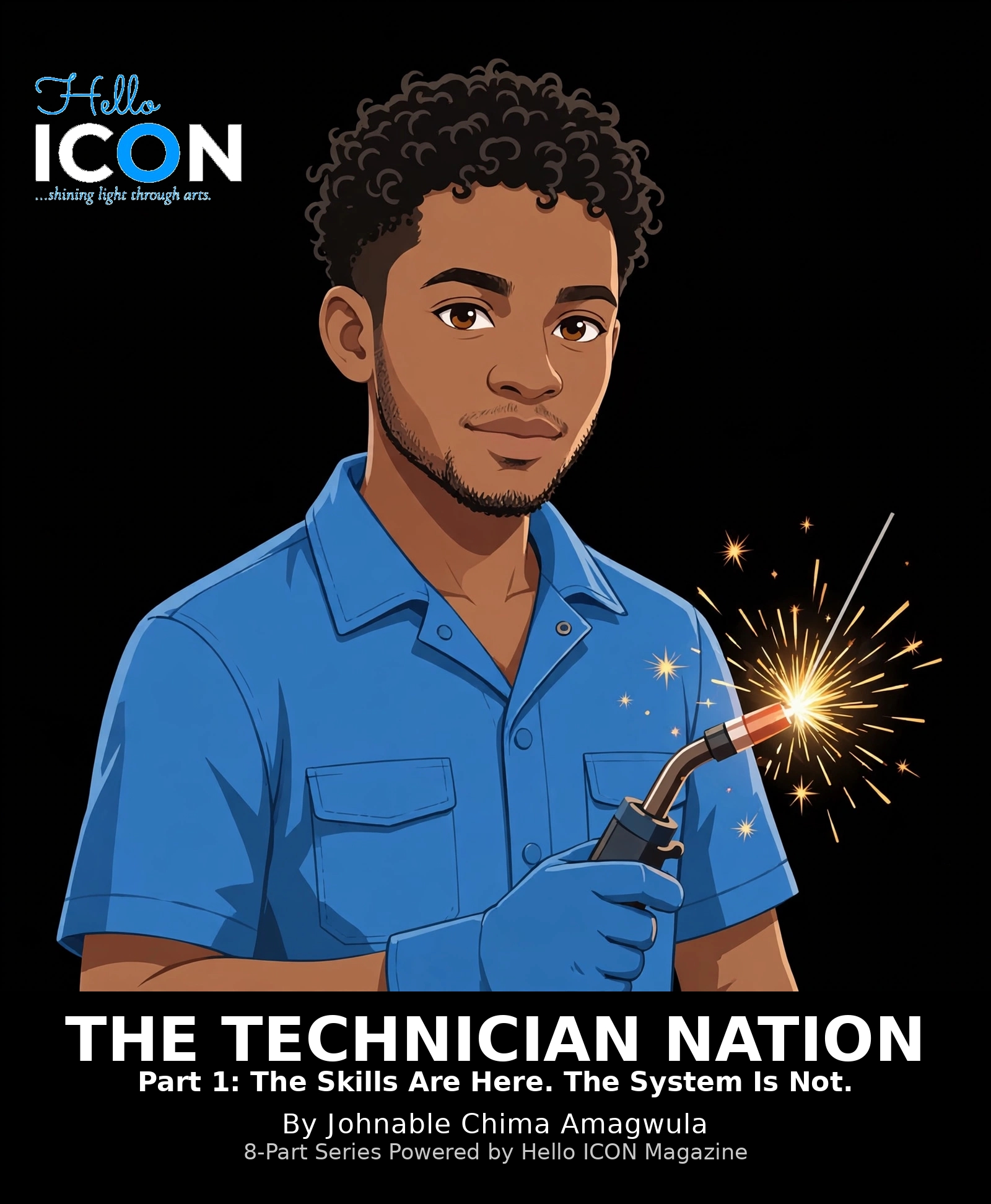
In a small workshop off the old Lagos road in Agbor, a welder can fabricate a gate, repair a tractor, and build a cassava grater from scrap. He has done it for fifteen years. What he does not have is reliable power, a CNC machine, a testing lab, or a single government contract.
He is not unskilled. He is disconnected.
That disconnection is Nigeria’s real industrial problem.
For years, industrialization has been framed as a shortage of talent. The evidence points to something else. The country has a large reservoir of technicians, artisans, engineers, planners, fabricators, ICT specialists, craftsmen, and designers. They are scattered, working in poorly serviced industrial clusters, residential neighborhoods, and small-scale enterprises.
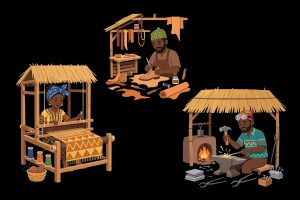
The structure does not match the capability.
The World Bank’s Nigeria Development Update, May 2025, reported that non-oil industrial growth was only 1.4 percent in 2024. It listed constraints that every technician knows: high input costs, limited access to credit, unreliable electricity, high internal trade and transport costs. The report also stated that macroeconomic stabilization alone will not produce structural transformation. Nigeria needs more and better jobs at scale.
A technician may be able to fabricate machinery but lacks modern workshop infrastructure, reliable electricity, industrial testing facilities, quality certification, access to finance, formal procurement markets, and opportunities to collaborate with engineers and manufacturers. The knowledge remains trapped in low-productivity informal work.
Nigeria’s ranking in the 2025 Global Innovation Index shows this contradiction. The country ranked 105th out of 139 economies. It performed relatively better in business sophistication at 55th and knowledge and technology outputs at 76th, but fell to 125th in human capital and research and 126th in institutions and infrastructure.
Nigeria has innovative and entrepreneurial capacity. It does not have sufficient institutional and infrastructural systems to convert that capacity into broad-based productivity.
The policy window for that conversion is now open.
In February 2026, the Federal Government launched Industrial Policy 2025. The policy identifies fragmented value chains, high production costs, infrastructure gaps, and weak coordination between government and industry as major problems, while emphasizing production, competitiveness, value chain development, MSME integration, skills, technology, and innovation.
In April 2026, the National Economic Council was informed that the Nigeria Industrial Cluster Programme had identified 76 clusters requiring investment, with an estimated potential to generate 2.74 billion dollars in revenue over 25 years.
The direction is clear. What is needed is a spatial framework that can hold these pieces together.
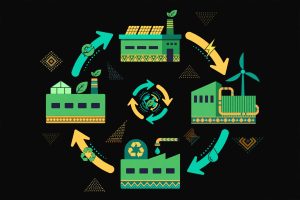
Illustration by: Hello ICON Magazine
This series proposes that framework: the Eco-Industrial Park.
An EIP is more than an industrial estate. Under the framework developed by UNIDO, the World Bank, and GIZ, it is a community of businesses located on common property where enterprises, park management, service providers, and surrounding communities collaborate to improve economic, environmental, and social performance. Firms exchange materials, energy, water, waste, and by-products. Shared infrastructure and services lower production costs.
It is not simply about providing land for factories. It is about building a system where land, infrastructure, skills, technology, finance, research, markets, and environmental management work together.
The central proposition of this research is that strategically planned EIPs can transform Nigeria’s fragmented technical and professional workforce into an interconnected industrial innovation ecosystem.
If that ecosystem is built, the Agbor welder does not remain an informal artisan. He can become a certified technician, an industrial contractor, a small enterprise, and eventually a manufacturer.
That ladder, from artisan to technology developer, is the subject of this series.