

Editor’s Note: If an industrial estate is about land, an Eco-Industrial Park is about relationships. In Part 1, we established that Nigeria has the technicians but lacks the system to make them productive – in Part 2 of this 8-part series, Johnable Chima Amagwula explains the model we keep confusing with a regular estate.
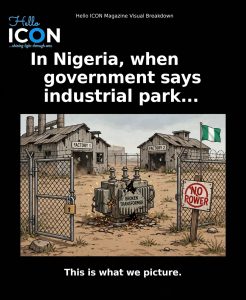
In Nigeria, when government says industrial park, most people picture fenced land, some roads, a transformer, and a few factories waiting for power that never comes.
That is not an Eco-Industrial Park. That is a real estate layout with industrial tenants.
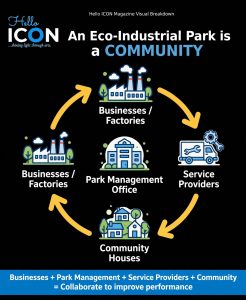
An EIP is different. Under the international framework developed by UNIDO, the World Bank and GIZ, an Eco-Industrial Park is a community of businesses located on common property where enterprises, park management, service providers and surrounding communities collaborate to improve economic, environmental and social performance.
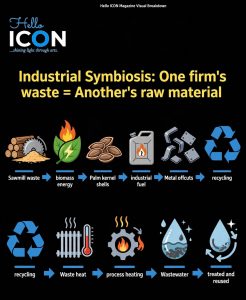
The core idea is simple but powerful: industrial symbiosis. One firm’s waste becomes another’s raw material. Sawmill waste becomes biomass energy. Palm kernel shells become industrial fuel. Metal offcuts go to recycling. Waste heat becomes process heating. Wastewater gets treated and reused.
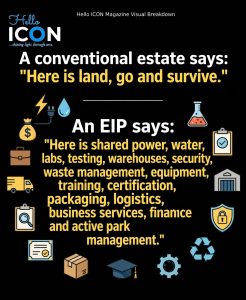
A conventional estate tells you: here is land, go and survive.
An EIP tells you: here is shared power, water, laboratories, testing facilities, warehouses, security, waste management, equipment, training, certification, packaging, logistics, business services, finance and active park management.
Look at the contrast:
Conventional Industrial Estate: Land allocation. Individual factories. Independent utilities. Waste disposal. Individual firms. Basic employment. Factory production. Conventional energy. Separate services. Passive management. Local market. Environmental compliance. Factory-centred.
Eco-Industrial Park: Integrated spatial-economic planning. Industrial ecosystem. Shared infrastructure. Waste-to-resource systems. Interconnected value chains. Skills and career development. Production plus innovation. Energy efficiency and renewables. Shared technical services. Active park management. Regional and global value chains. Environmental performance. Community and ecosystem-centred.
Why does this distinction matter for Nigeria?
Because UNIDO’s industrial park platform lists what makes parks effective: shared infrastructure, telecommunications, wastewater treatment, roads, laboratories, quality-control facilities, one-stop administrative services, financial services, training services and emergency services.
That list is exactly what a welder in Ladipo, a fabricator in Nnewi, a shoemaker in Aba and a leather worker in Sharada lack. They have the skill. They lack the system around the skill.
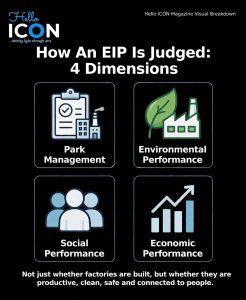
Under the international framework, an EIP is judged on four dimensions: park management, environmental performance, social performance and economic performance. Not just whether factories are built, but whether they are productive, clean, safe and connected to people.
An EIP is therefore not an environmental project. It is not a green slogan.
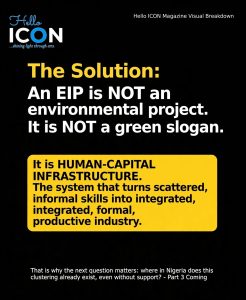
It is a human-capital infrastructure. It is the system that turns scattered, informal skills into integrated, formal, productive industry.
That is why the next question matters: where in Nigeria does this kind of clustering already exist, even without support?