


Editor’s Note: Eco-Industrial Parks have been tested globally. Some succeeded, some failed. In Part 3, we showed Nnewi, Aba and Kano already prove those relationships exist in Nigeria. In Part 4, Amagwula examines the evidence Nigeria should pay attention to.
The question is not whether Eco-Industrial Parks work. The question is under what conditions they work.
The Global Eco-Industrial Park Programme (GEIPP) ran pilots in seven countries – Colombia, Egypt, Indonesia, Peru, South Africa, Ukraine and Vietnam.
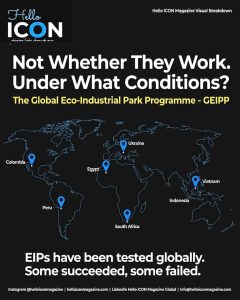
In its first phase alone, it reported savings exceeding 57 million kWh of energy, over 2 million cubic metres of water and 18,000 tonnes of materials. Firms saved money because they became efficient. Environmental efficiency generated direct economic value. It was not charity. It was industrial competitiveness.
In China, the evidence is stronger and at scale.
China built the largest EIP system in the world. A study of 93 national demonstration EIPs across 330 cities found that EIPs increased economic growth in pilot cities by 7.47 to 7.61 percent. The drivers were not just more factories, but structural effects, technological effects and scale effects.
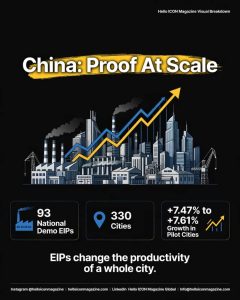
It proves EIPs don’t just affect factories. They affect urban economic performance. They change the productivity of a city.
Vietnam shows the SME angle, which is critical for Nigeria.
In one set of interventions involving 20 firms, cleaner production assessments generated about $500,000 in annual savings while reducing solid waste, electricity and water use. That is $25,000 per firm per year in savings, money that goes back into business expansion and jobs.
Vietnam’s industrial zones later became the backbone of its export system because they solved the basics: infrastructure, energy, water, waste, for SMEs.

Ethiopia provides the African comparison and the caution Nigeria must heed.
A 2024 study found EIPs in Ethiopia created employment, attracted foreign direct investment, increased exports and improved skills development. But the same study found negative environmental, economic and social effects when parks were poorly managed: pollution, displacement, high operating costs and community conflict.
More recent UNIDO reporting shows over 101,000 jobs across three integrated agro-industrial parks in Ethiopia. The model can work in Africa. It must be managed professionally.

Nigeria already has its own evidence. We don’t need to guess.
A 2024 assessment of Sharada Industrial Park in Kano found only 39% of international EIP indicators were being met. Problems included resource inefficiency, pollution, operating costs and weak management. But it also identified transformation opportunities: industrial diversity, existing infrastructure and renewable energy integration.
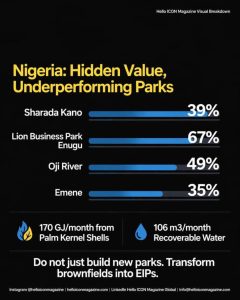
In Enugu, a 2025 assessment scored Lion Business Park at 67% EIP readiness, Oji River at 49% and Emene at 35%. It also found hidden value that nobody was using: 170 GJ per month of energy potential from palm kernel shells and 106 cubic metres per month of recoverable water from waste streams.
The message is clear. Nigerian parks are not empty. They are underperforming and full of hidden resource value. We are throwing away money we could be recycling.
The strategy for Nigeria should not be just building new parks. It should be brownfield-to-EIP transformation: turning existing estates like Sharada, Emene and Oji River into proper Eco-Industrial Parks.