

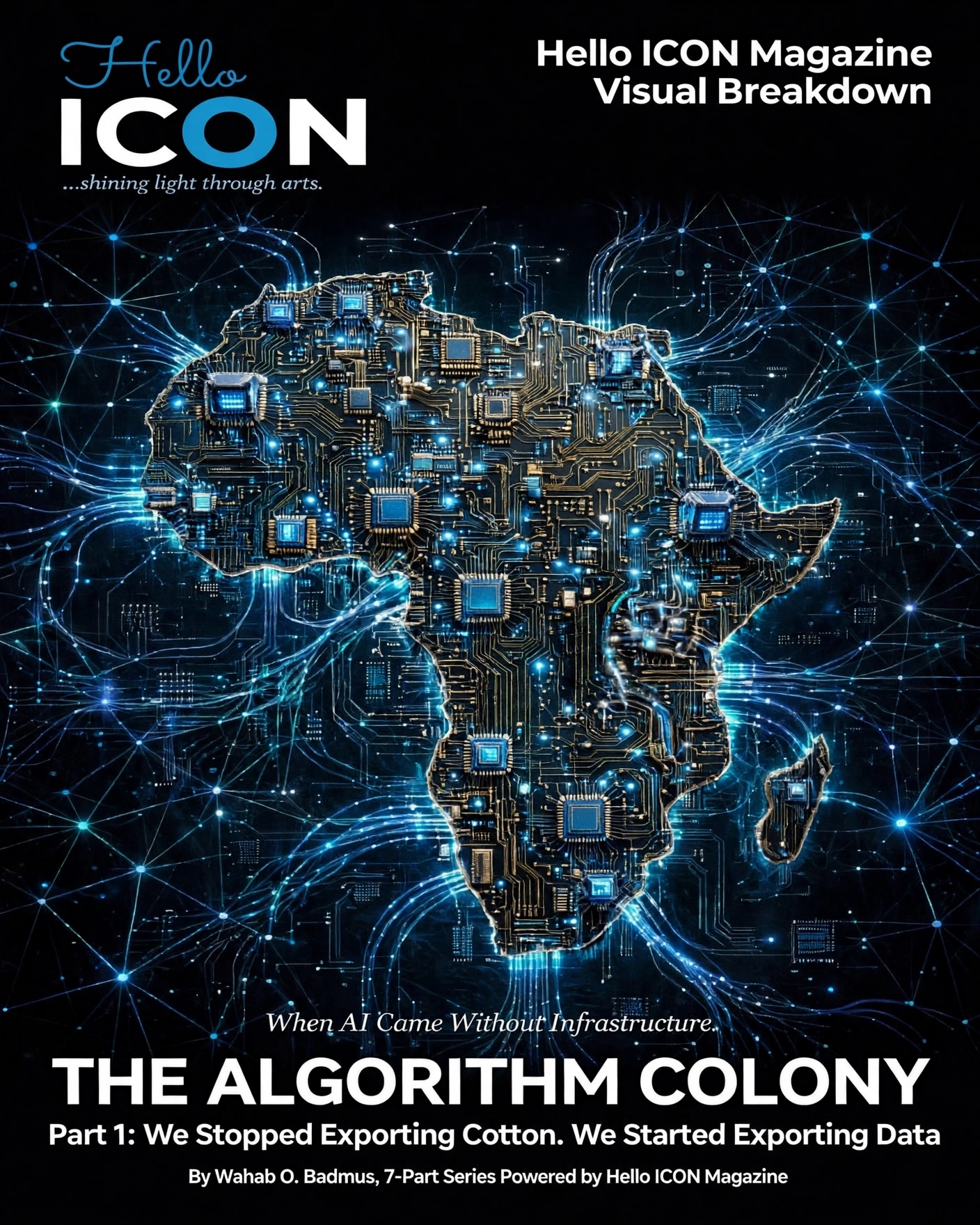
Editor’s Note: Africa has 18 percent of the world’s people and 0.6 percent of its data centres. In Part 1 of this 7-part investigative series, Wahab O. Badmus shows how we moved from industrial exclusion to algorithmic dependency.
In 1890, they built railways to take cotton from Kano to the port. By 2026, they had built fiber cables to take your face, your voice, and your bank ID (BVN) to Virginia.
The pattern did not change. The commodity did. For 20 years we were told Africa missed the industrial revolution. Now they say we will not miss the AI revolution.
But look at the numbers.
Africa holds 18 percent of the global population. We hold less than 1 percent of global data centre capacity. 0.6 percent, to be exact. South Africa holds more than 66 percent of what little we have. Central Africa has almost nothing.
29 African countries have written AI strategies. The African Union endorsed its Continental AI Strategy in July 2024. Egypt scored 100 in Policy Capacity, tied number one globally. Nigeria scored 80.5. Rwanda scored 73.
We are good at writing policy. We are not building hardware.
In Kenya, buying one enterprise GPU costs 75 percent of what an average person earns in a year. In Senegal, it is 69 percent of annual per capita GDP.
So 95 percent of African researchers build on free Google Colab. The kind that disconnects when light blinks. The kind that cannot train anything serious.
That is not a talent problem. That is an infrastructure problem.
The result is simple. We generate data here. They process it there.
Your hospital data in Lagos. Your land registry in Kigali. Your mobile money in Nairobi. Your farm records in Egypt. Your farm photo that a model uses to predict yield.
They travel through 2Africa and Equiano subsea cables, land in server farms in Northern Virginia or Marseille, train a model, and come back to you as a monthly subscription.
$20 per user. In dollars. Every month. To use what your own data trained.
Government pays in dollars. Startups pay in dollars. That is foreign exchange leaving the country forever.
It is cotton all over again. Export raw. Import finished.
Except now the raw material is not cotton. It is your behaviour.
In the 19th century, the industrial core had steam power, factories, and coal. The periphery had raw materials and labour.
In the 21st century, the core has GPU clusters, data centres, and Large Language Models. The periphery has raw data and cheap annotation labour.
Thousands of young Africans in Nairobi, Lagos, and Cairo label images, moderate toxic content, and clean text for global AI platforms for less than $2 an hour. No mental health support. No contract. No name in the paper.
Their work teaches the model to be less racist, less violent. The model is then sold back to their own government as a governance tool.
This is the question this series will answer.
How did historical inequality become algorithmic dependency? How bad is it in Egypt, Kenya, South Africa, Nigeria, and Rwanda, the five anchors that take 72 to 82 percent of all tech funding? And what do we actually need to build to escape it?
AI is no longer just an app. It is tax collection. It is health triage. It is land management and social welfare allocation.
If we do not control the stack, we do not control governance.
Next week in Part 2, we go back to 1750. To understand why Britain had 4 times India’s income then, and why the US now spends $750 billion on AI while we have no enterprise cloud node in Central Africa.